Solid wood or veneer? How to recognise real quality
Two desks, almost identical to look at, and a price difference of several thousand euros. One is solid wood, the other veneered. To tell them apart with confidence you don’t need a joiner’s training, just four clear checks. This guide is an honest look at where the two differ, and at how to tell from the desk itself what you really have in front of you.

At a glance
The short version
|
Who this article is for
|
The short answer
Solid wood is real wood from top to bottom. Veneer is real wood only at the surface. At the desk, the quickest way to tell is the edge: on solid wood the grain runs on around the edge without a break, on veneer the thin layer of real wood ends with a visible join. For a desk in daily use, solid wood lasts longer, can be repaired and holds its value better. | |

Solid wood and veneer: the difference in construction
The difference isn’t in the look. It’s under the surface. Solid wood is real wood through and through: a top made of glued-up staves is the same material from top to bottom, with the same grain, the same density and the same weight.
Veneer, by contrast, is a thin layer of real wood, usually 0.5 mm to a few millimetres thick, glued onto a core of chipboard, MDF or plywood. To look at, a good veneer comes close, because the layer you see is real wood. The core underneath is not.
Important: veneer is not a cheat, and it isn’t a cheap material in itself. On a stable core it has its place, for large fronts or curved shapes, for instance. The question isn’t “good or bad”. It’s this: what do you need for a desk you work at every day?
Durability: what lasts a working life?
A desk isn’t an ornament. It carries weight, takes knocks, gets wiped down and leaned on. This is where the difference in material shows most clearly.
Solid wood is dimensionally stable and robust, and is often passed down through generations. Veneer wears faster, above all in the places that take the most use:
- at edges and corners, where it gets knocked every day;
- where your forearms rest;
- once the thin layer of real wood has worn through, the core shows, and the look can hardly be rescued.
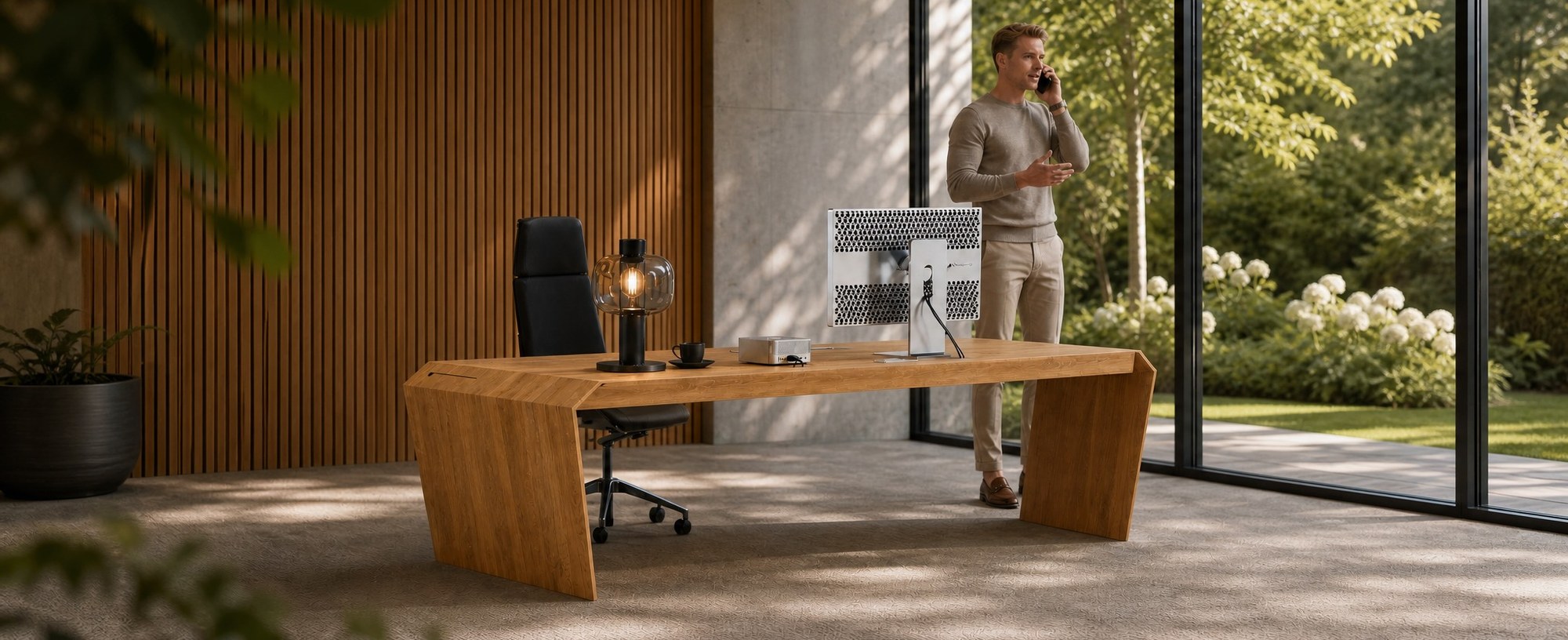
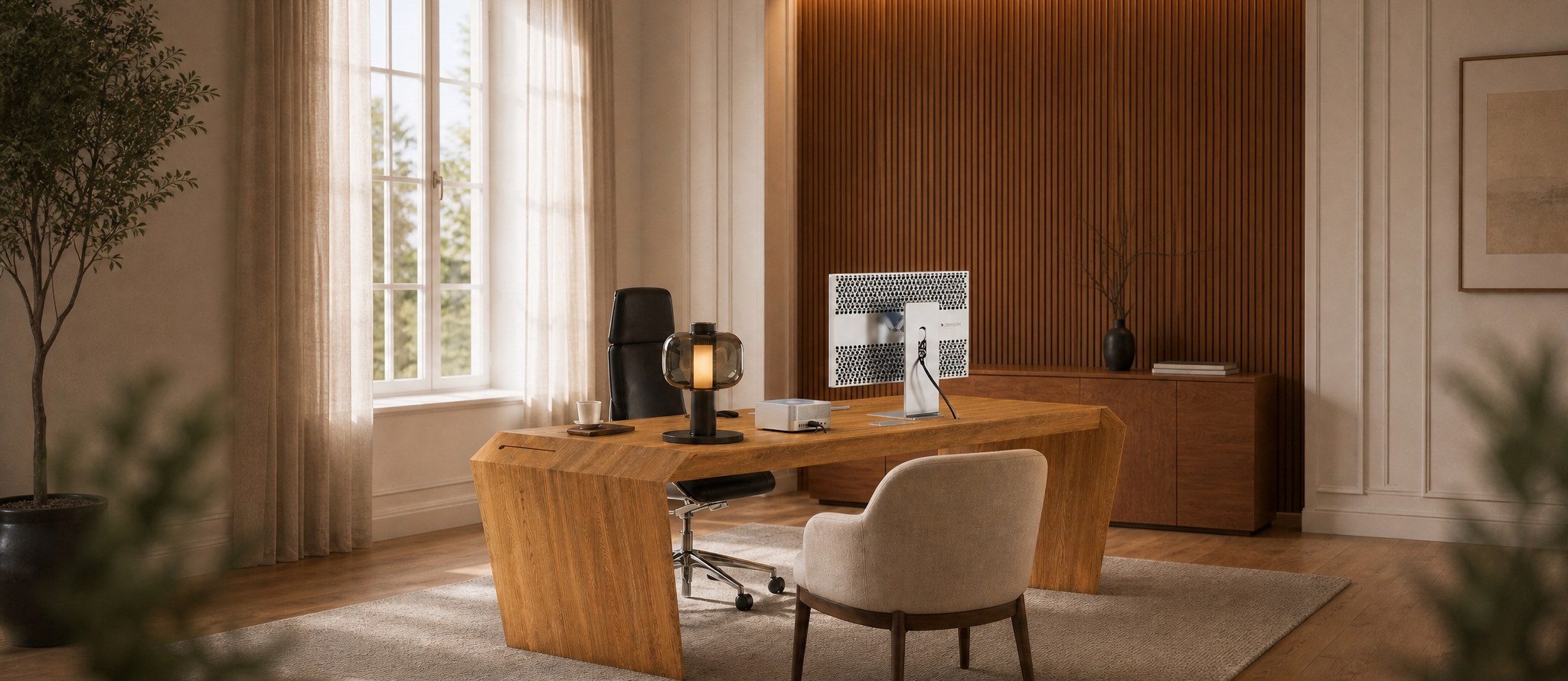
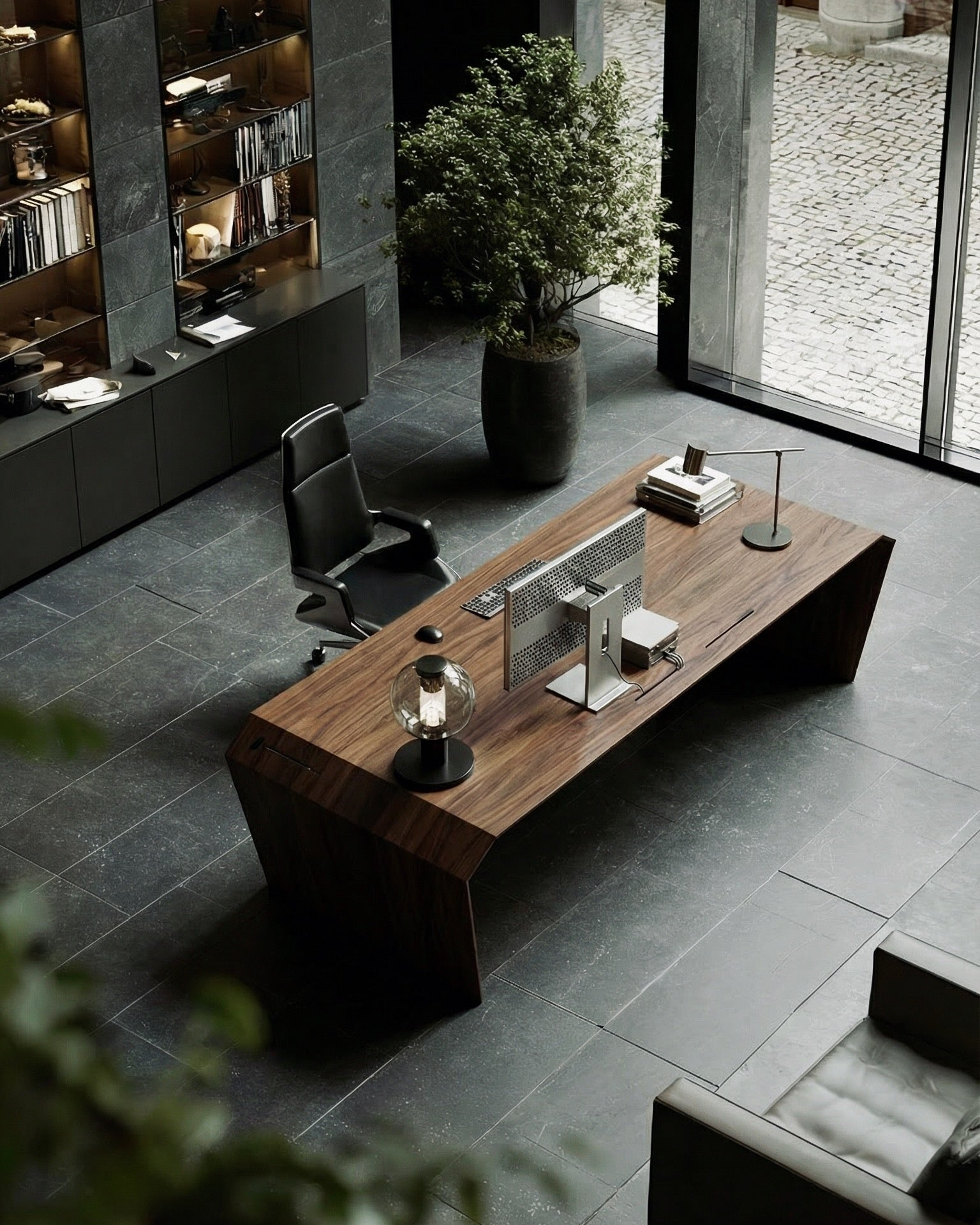
That’s exactly why the DeskPURE and the whole EDELHOLZ range are built, without compromise, in 26 mm solid wood, oak or American walnut, with no veneer. A top of that thickness, solid all the way through, has a stability that a veneered construction doesn’t match.

“Compared with veneered desks or other coated desks, it’s a different world. You just love sitting at it, and when you touch the surface it’s an incredibly pleasant feeling.”
Repairability: the difference that decides it day to day
No desk stays flawless. Sooner or later there’s the scratch, the water ring, the dent from the monitor stand. What happens next separates solid wood and veneer for good.
Solid wood can be sanded back, re-oiled or re-stained, and then looks like new again. Because the wood runs all the way through, you can repair a damaged spot as often as you need to.
With veneer that’s hardly possible. The layer is so thin that, at most, it can be carefully reworked by hand, never by machine. Sand too deep and the core is exposed. In practice a veneered desk is rarely repaired. It gets replaced. A solid wood desk is refurbished, and stays.

Feel and the sense of quality: what you notice before you know it
Most people feel the difference as soon as they lay a hand on the top, without being able to name it. Solid wood feels cool, dense and substantial. The edge has depth, and the surface has a liveliness that comes from natural grain, which never repeats exactly.
A veneered desk often looks similar from above, but gives itself away at the edge, in the sound and in the weight. If your desk is also part of how you present yourself, in your own office, in a client meeting or in the background of a video call, you’ll value that sense of quality.
That sense of quality can’t be printed on. You feel it at the edge before you can put a name to it.


The price: why solid wood costs more, and why it pays off
The price difference is real: solid wood costs several times as much as veneer, because more high-grade timber, more time spent selecting it and more work by hand go into it. That isn’t margin. It’s substance.
From a business point of view, though, what counts is not the purchase price but the cost over the years of use. A veneered desk that is replaced after a few years often ends up costing more than a solid wood desk that stays, gets refurbished and holds its value. Well-kept solid wood furniture even resells well later on, while veneered pieces usually lose value.
At EDELHOLZ the starting prices are as follows:
- the pared-back DeskPURE from 4.400 €;
- the DeskPRO with two soft-close drawers as standard, from 5.400 €;
- the ArcPURE with its 120-degree angle brings the L-shape to the office, in the same solid oak or walnut.
If you’d rather spread the investment over time, there’s business leasing (Germany only), with a monthly payment and a regular VAT invoice. In Germany it is deductible as a business expense. Check with your accountant.
The four checks: how to recognise solid wood at the desk
You don’t have to guess. Four checks are enough to tell the two apart with confidence, and you can do all of them yourself.
- 1. The edge. It tells you the most. On solid wood the grain runs on around the edge without a break, and surface and edge visibly belong together. On veneer the layer ends at the edge, often with a seam, a glued-on lipping or a different grain pattern. Layers visible at the edge mean veneer.
- 2. The grain. Natural grain never repeats exactly. With veneer, identical or mirrored leaves are glued side by side, so the same pattern turns up again after 5 to 20 cm. A repeating pattern is a warning sign.
- 3. Weight and sound. Solid wood is heavy and dense, and sounds full and rich when you knock on it. Veneer on chipboard or MDF often sounds hollower and lighter. On its own that’s no proof, but together with the edge it’s a clear indication.
- 4. The origin. Ask. “Real wood” isn’t a reliable term, because veneer is real wood too, only wafer-thin. Get a specific answer: solid wood all the way through or a veneered core board, and how thick?
At EDELHOLZ the answer is clear: 26 mm solid oak or American walnut, made to order in our workshop in Germany. If you’d like to hold the grain in your own hands first, order a wood sample.
Four finishes
Solid wood doesn’t mean giving up choice. You can see three standard finishes as renderings in the configurator:
- Golden Timber (oiled oak);
- Deep Walnut (American walnut);
- Midnight Noir (pigmented, oiled oak).
Then there’s Smoked Amber, oak stained and lacquered in a smoked-oak tone. All finishes are oiled or lacquered on solid wood that runs all the way through, not on veneer, and can be refurbished later. If you need a colour or a size outside the standard, the route is a bespoke piece: a different width, depth or height, worked out with you one to one.
Your chosen height instead of a mechanism
One point where EDELHOLZ openly goes against the trend: the desks are not electrically height-adjustable, and that’s deliberate. Instead of a motorised mechanism, which would be a foreign body in a solid wood desk and which ages or fails, you set the height once, and set it right. Standard height is 76 cm, and when you order you can choose anywhere between 72 and 82 cm, to suit your height and your chair. It isn’t a sit-stand desk. It’s your chosen height, as part of building the desk to measure. The result is maximum stability and a calm, closed construction, with no technology that will give out one day.
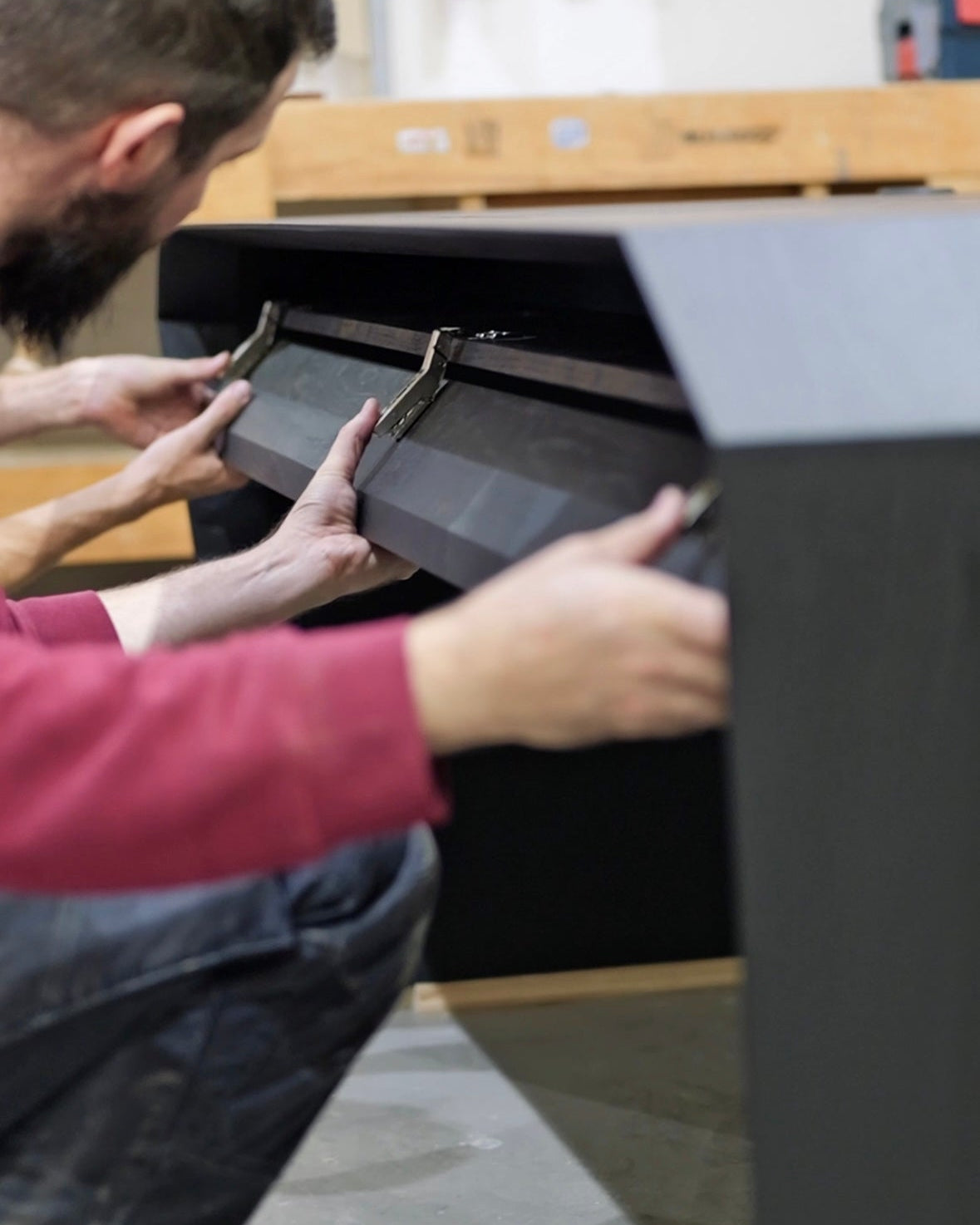
Cable management is built in as standard, not sold as an add-on: CableHIDE sits under the top, a flap in solid oak or walnut with a 6-way power strip, two USB-A and two USB-C ports, and a 5 m fabric cable. If you want more, add options such as PowerLINK, SmartCHARGE or the CenterDRAW pull-out tray (for the DeskPRO and ArcPURE).

Frequently asked questions
How can I tell whether a desk is solid wood or veneer?
Is solid wood really better than veneer?
Why is a solid wood desk more expensive?
What wood are EDELHOLZ desks made of?
Can a solid wood desk be repaired if it gets scratched?
Why aren’t the desks height-adjustable?
Is a solid wood desk worth it in Switzerland, despite the delivery cost?
In short: veneer can be right, solid wood lasts
Veneer is not a bad material. For a lot of furniture it’s a sensible, affordable answer. But for a desk you work at every day, almost everything points to solid wood: durability, repairability, feel and lasting value. To be sure, check the edge, the grain, the weight and the origin. If you’re planning your model yourself, the configurator will help, and you’ll find more on wood, ergonomics and furnishing in the EDELHOLZ Journal.
Stop guessing. Configure your desk.
We’ll talk your project through with you personally, or you go straight to the model that fits.

Philipp Strobel is a qualified automotive engineer. He brings an engineer’s way of thinking to running a business, and develops desks in which function and design come out of one system. He has been developing products in wood since 2017, and since 2024, with EDELHOLZ, desks for business owners.