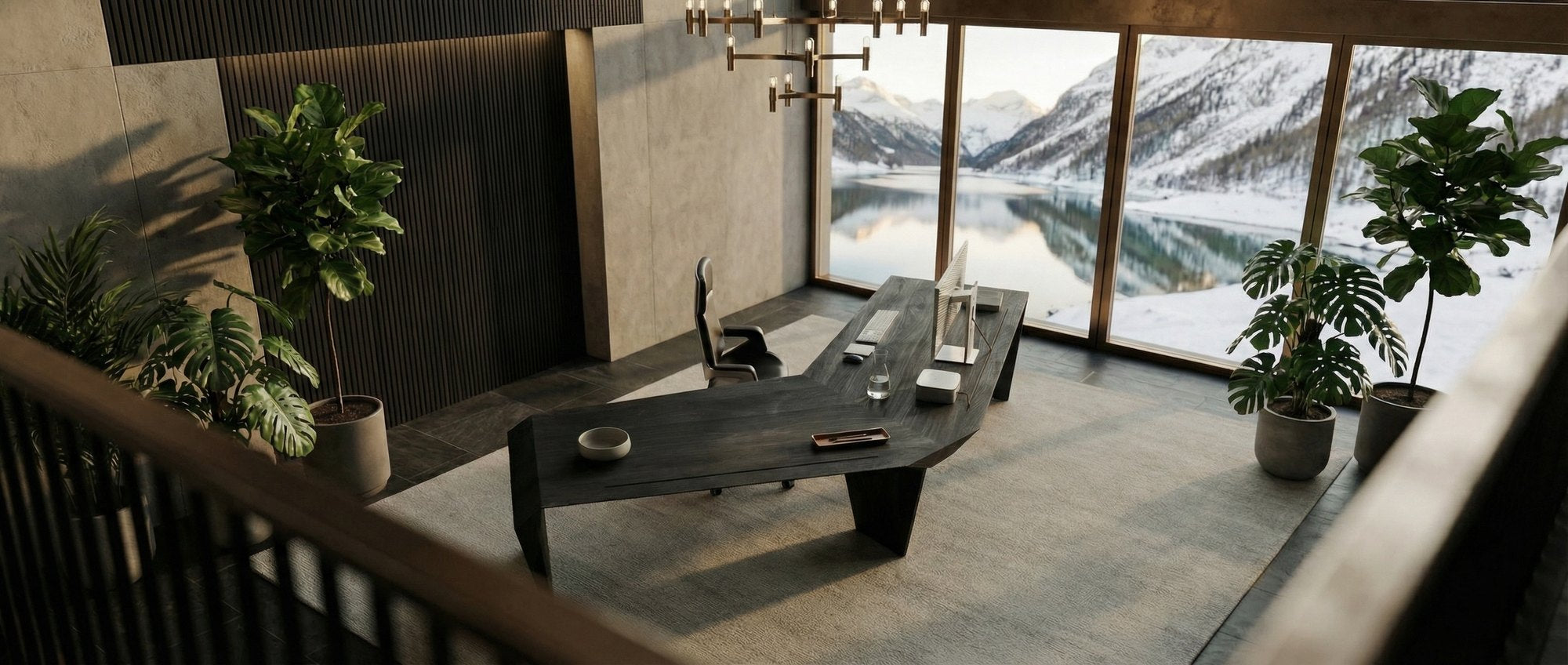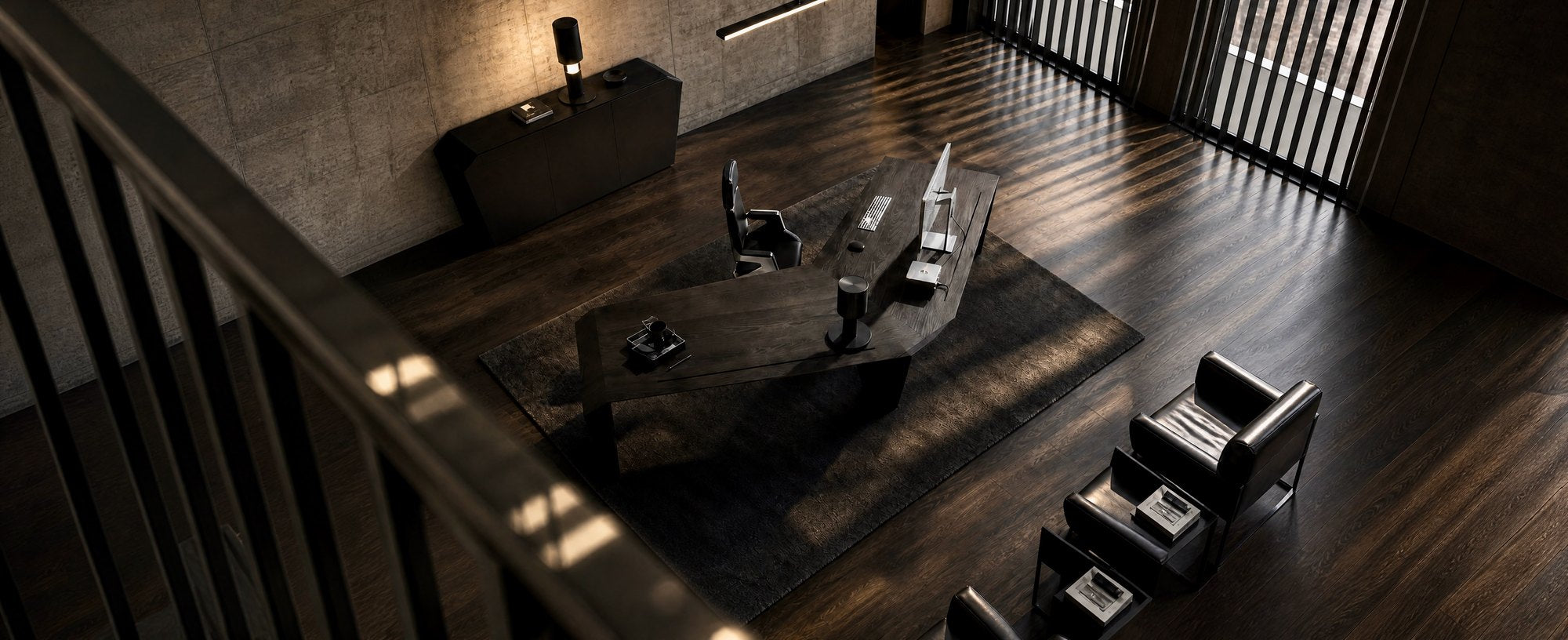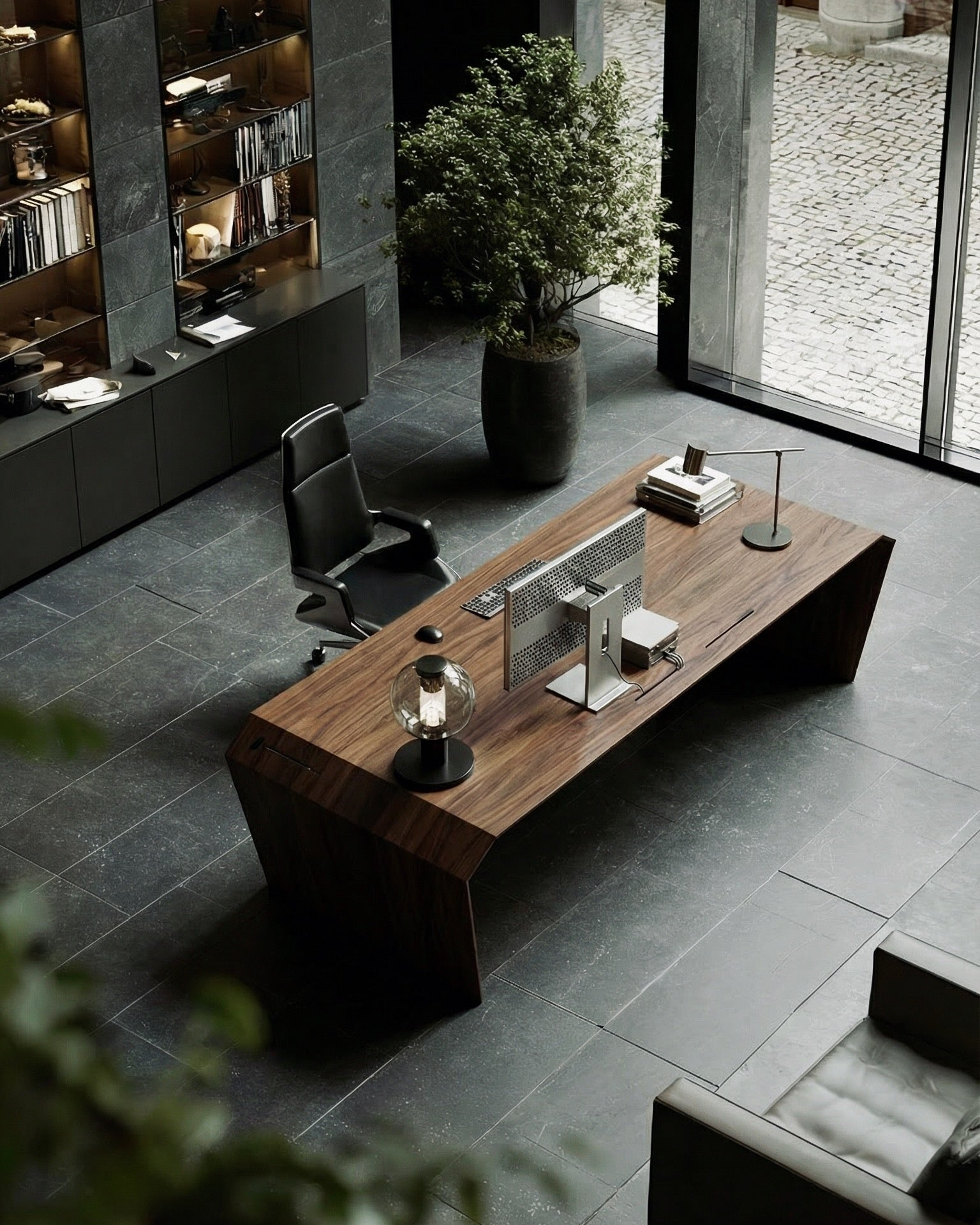
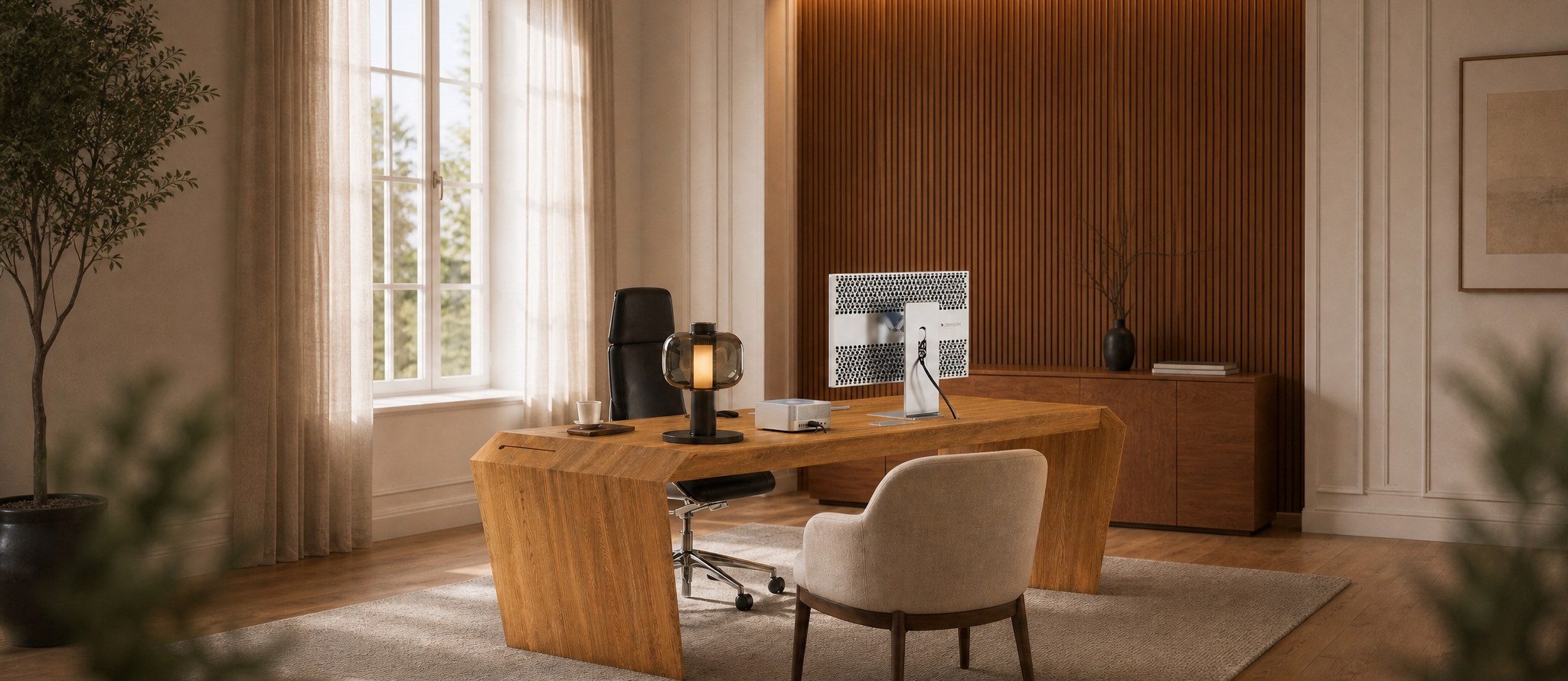
Is a height-adjustable desk worth it? Why we build to a fixed height instead
For many people the height-adjustable desk is a given. Yet more and more are asking themselves honestly: do I really need the motor, or will I end up using one height anyway? This guide weighs the pros and cons fairly and explains why we at EDELHOLZ deliberately build fixed desks in solid oak and walnut, at a height you choose, rather than fitting a motor.

At a glance
The short version
|
Who this article is for
|
The short answer
A height-adjustable desk is worth it if you genuinely switch between sitting and standing, and keep it up. For most people, though, a fixed height that is set correctly brings the same ergonomic benefit day to day, without a mechanism that can fail. That’s why EDELHOLZ builds fixed desks in solid oak and walnut at a standard height of 76 cm. You set it anywhere between 72 and 82 cm when you order: your height, made to measure, no sit-stand mechanism. | |
Hardly any question comes up as often in our conversations as this one: is a height-adjustable desk really worth it, or is a fixed height enough? The honest answer is that it depends, and less on the desk than on you. Rather than praising or dismissing the sit-stand desk wholesale, we’ll look at what adjustability actually delivers in daily life, where its weaknesses lie, and why we at EDELHOLZ have deliberately taken a different path.

What ergonomics is really about
Before we talk about adjustability, it’s worth looking at the actual goal. What matters ergonomically is that, sitting upright, your forearms rest level on the top, your shoulders stay relaxed and your eyes fall slightly downwards to the top edge of the screen. That posture is what keeps neck, shoulders and back relaxed over hours.
The right height is the biggest lever for that. Not whether it can be changed at the push of a button. A desk built exactly to your height fits perfectly every single day. An adjustable desk left at the wrong setting, because you never really adjust it, does little for you. Ergonomics comes from the right setting, not from the option to change it.
For: when a height-adjustable desk really is worth it
Being fair means naming the strengths clearly. A height-adjustable sit-stand desk has real advantages, and for some people it is the right choice:
- A genuine change between sitting and standing. If you genuinely change posture, and keep it up, standing for longer stretches several times a day, you’ll gain more movement in your working day.
- Shared desks. Where several people use the same desk in turn, a quick height change is practical, in co-working spaces or shift work, for instance.
- Specific health reasons. With certain back or circulation conditions, regular changes of position may be advised by a doctor and genuinely wanted.
The common thread in all these cases: the adjustability is actually used, and used regularly. That is exactly where theory and practice tend to part ways.
Against: the points nobody tends to mention
As often as the sit-stand desk is recommended, its weaknesses are rarely discussed. Yet you feel them clearly in daily use:
- The adjustment is often barely used. Many people set the desk to a comfortable height after a few weeks and leave it there. The sit-stand desk becomes, in effect, a fixed desk with a motor underneath.
- Standing all day isn’t automatically healthy. Working on your feet for hours puts strain on legs, joints and circulation, and is no better than sitting for hours. The health benefit comes from movement, not from height alone.
- A motor is a wearing part. Motor, controls and mechanism can fail, hum or develop play over time. What glides smoothly today may be a repair job in a few years.
- Stability suffers. An extending frame is more likely to wobble at full height than a fixed one, especially with heavy monitors or a solid top on it.
- Looks and feel. Visible lifting columns, a control panel and cables rarely sit well with a calm, well-made desk in solid oak or walnut. Technology takes over where the wood should do the talking.
None of these points makes the height-adjustable desk a bad one. But they explain why, for many people, a fixed height is the more honest answer in the end.

The health benefit at a desk comes from movement, not from a motor. Standing up regularly, taking a few steps and changing posture does more for your back than any electric lift.
How high should a desk be?
The standard height for desks is around 72 to 76 cm, which is why many desks leave the factory at 74 or 76 cm. That norm is a compromise for an average height, so it doesn’t suit everyone equally well. As a rough guide:
- up to about 1.70 m tall, 72 to 74 cm tends to feel comfortable;
- between 1.70 and 1.85 m, the classic height is around 74 to 77 cm;
- from about 1.85 m upwards, 77 to 82 cm is often the better choice.
These figures are pointers, not fixed rules, because the seat height of your chair, your leg length and the way you work all play a part. What decides it is how the posture feels: forearms level, shoulders loose, no hunching. And this is exactly where a fixed height, chosen for you and built in, shows its real advantage. It is tuned precisely to you and stays put, instead of being nudged out of place in daily use.

“It almost looks as if it’s about to fold in on itself, but it is so solid and so stable. It looked great in the photo, and it’s wonderful that it’s exactly the same in real life.”

Our way: a fixed height to your measure, no motor
At EDELHOLZ we deliberately decide against electric height adjustment, and we do so out of conviction. Instead of a motorised mechanism, which would be a foreign body inside a solid oak or walnut frame and can fail over time, we build the height in, tailored to you. In practice it works like this:
- The standard height is 76 cm.
- When you order, you choose your height anywhere between 72 and 82 cm.
- This is not electric height adjustment and not a sit-stand desk. It is your height, made to measure.
- Tell us how tall you are, or the height you want, and we build the desk exactly to it.
At heart the difference is simple. You get the main ergonomic advantage, a height that fits you exactly, without the drawbacks of a motor. Maximum stability, no wearing parts, no vibration under your hand, and a calm, closed construction where the wood does the talking, not the technology.
What a fixed construction means day to day
A fixed frame in solid oak or walnut carries weight differently from an extending one. Heavy monitors, a solid 26 mm top, the pressure when you lean on it: a fixed construction takes all of that without a wobble. There’s no lifting column to develop play over the years, and no motor to start humming or refuse to work one day.
And there’s a point that counts especially in an office that represents you. A desk from EDELHOLZ is not a piece of technology. It’s a calm, well-made piece of furniture. That’s exactly why our desks are not height-adjustable in the electric sense, but built to the height that is comfortable for you. That applies to the DeskPRO with its two soft-close drawers as standard, the purist DeskPURE and the L-shaped ArcPURE corner desk for larger offices.
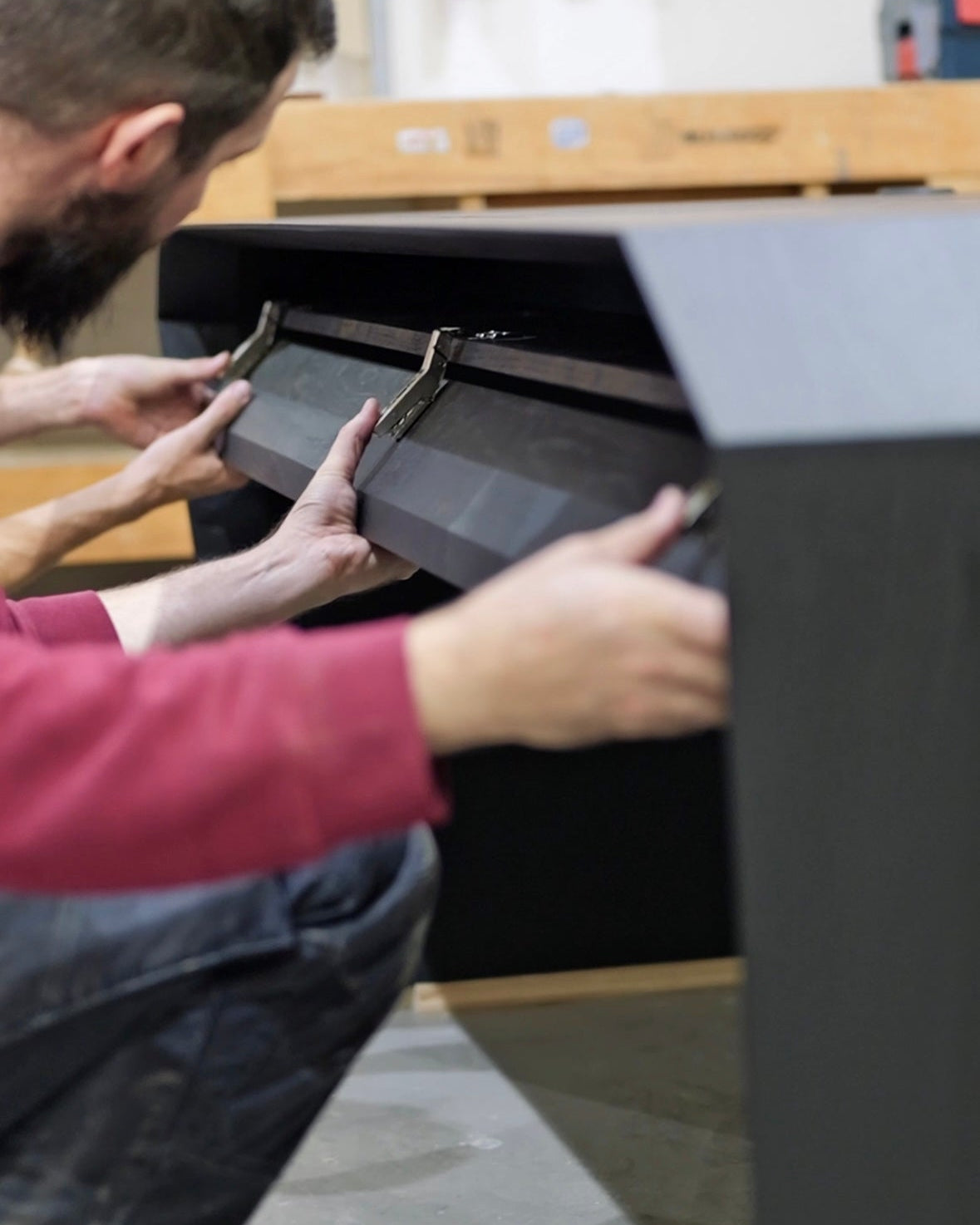
The technology stays where it belongs, too: out of sight. The CableHIDE cable compartment comes as standard, at no extra cost. Behind a solid oak or walnut flap under the top sit a 6-way power strip with two USB-A and two USB-C ports and a 5 m fabric cable. If you want more, the configurator offers optional add-ons such as the CenterDRAW pull-out tray, PowerLINK or the SmartCHARGE MagSafe charging pad.
Who a fixed height is the better choice for
In our experience the decision is fairly clear-cut. A fixed height, made to your measure, is the better choice if you recognise yourself in these points:
- You work sitting down almost all the time anyway, and when you want to move you’d rather get up properly than stand at the desk.
- Stability, build quality and the feel of a well-made piece matter more to you than a motor.
- You want a piece of furniture that lasts for years and contains no technology that ages or fails.
- The desk stands in a client-facing office, or in the background of your video calls, where a calm picture counts.
If, on the other hand, you really do need the constant change between sitting and standing, and stick to it, then a classic sit-stand desk is, honestly, the better tool. We deliberately don’t build for that case. We build for everyone who wants a fixed desk in solid oak or walnut, set perfectly to them.

And if the height you want is outside that range?
The free choice of height between 72 and 82 cm covers the vast majority of people comfortably. If you need something beyond that, or a different width or depth, the route is a bespoke piece. We agree the dimensions with you personally, from the size of the top to the height, so the desk fits your room and your build exactly.
If you’re planning the whole picture, think about the same wood for more than one piece. A StudioPURE sideboard in the same solid oak or walnut complements the desk, a ForumPURE conference table rounds off a larger office, and for a living area or waiting room there’s the LoungePURE coffee table. If you’d like to feel the finishes first, order wood samples (10 € each) and have oak and walnut physically on the table in front of you. And if you’d rather spread the investment over time, there’s business leasing (Germany only) with a monthly instalment and a regular invoice including VAT.
Frequently asked questions
Is a height-adjustable desk really worth it, or is a fixed height enough?
How high should a desk be?
What are the drawbacks of a sit-stand desk?
Are EDELHOLZ desks height-adjustable?
Is standing at a desk healthier than sitting?
Why does EDELHOLZ deliberately build fixed desks rather than motorised ones?
Can I choose my height freely, even below 76 cm?
In short: what matters is the right height, not necessarily the mechanism
A height-adjustable desk is worth it if you genuinely switch between sitting and standing, and keep it up. For everyone else, and that is most people, a fixed height that is set correctly brings the same ergonomic benefit day to day, with no motor to fail, no wobble and no visible technology. That is exactly what we build for at EDELHOLZ: fixed desks in solid oak and walnut at a standard height of 76 cm, chosen anywhere between 72 and 82 cm, your height made to measure. If you’re unsure, plan your model in the configurator or talk the right height through with us directly. More on wood, ergonomics and furnishing is in the EDELHOLZ Journal.
Your height instead of a motor: let’s talk your desk through.
We’ll talk your project through with you personally, or you go straight to the model that fits.

Philipp Strobel is a qualified automotive engineer. He brings an engineer’s way of thinking to running a business, and develops desks in which function and design come out of one system. He has been developing products in wood since 2017, and since 2024, with EDELHOLZ, desks for business owners.