Oak or walnut? Which wood for your desk
It’s the question before almost every order: oak or walnut? Both are solid timber and both last for decades. Yet they are two completely different characters. Which one suits your office comes down to looks, the room and your own taste.

At a glance
The short version
|
Who this article is for
|
The short answer
Oak suits bright, smaller or modern Scandinavian-style rooms and is a little tougher. American walnut brings warmth and presence to larger, well-lit offices. If you’re torn, the most honest way to decide is with the wood samples in your own light. | |
Why only these two timbers?
Every EDELHOLZ desk is made from 26 mm solid timber, not veneer. Veneer is a layer of real wood a few tenths of a millimetre thick on a carrier board. Solid timber, on the other hand, is through and through what it claims to be. You can feel it at the edge and in the weight. And the surface can be worked over for years, instead of the first deep scratch exposing a core that can’t be repaired.
We deliberately limit ourselves to two wood types. There are good reasons for both:
- Both are hardwoods: tough and long-lasting in everyday office life.
- Stable enough for a calm, perfectly flat work surface.
- They age well: they get better with the years, not worse.
Instead of offering twelve middling timbers, we concentrate on two that we have mastered. You choose wood and model separately. How this idea of real solid timber turns into a finished desk is clearest in the workshop, from the rough log to the finished edge.
From log to top to desk
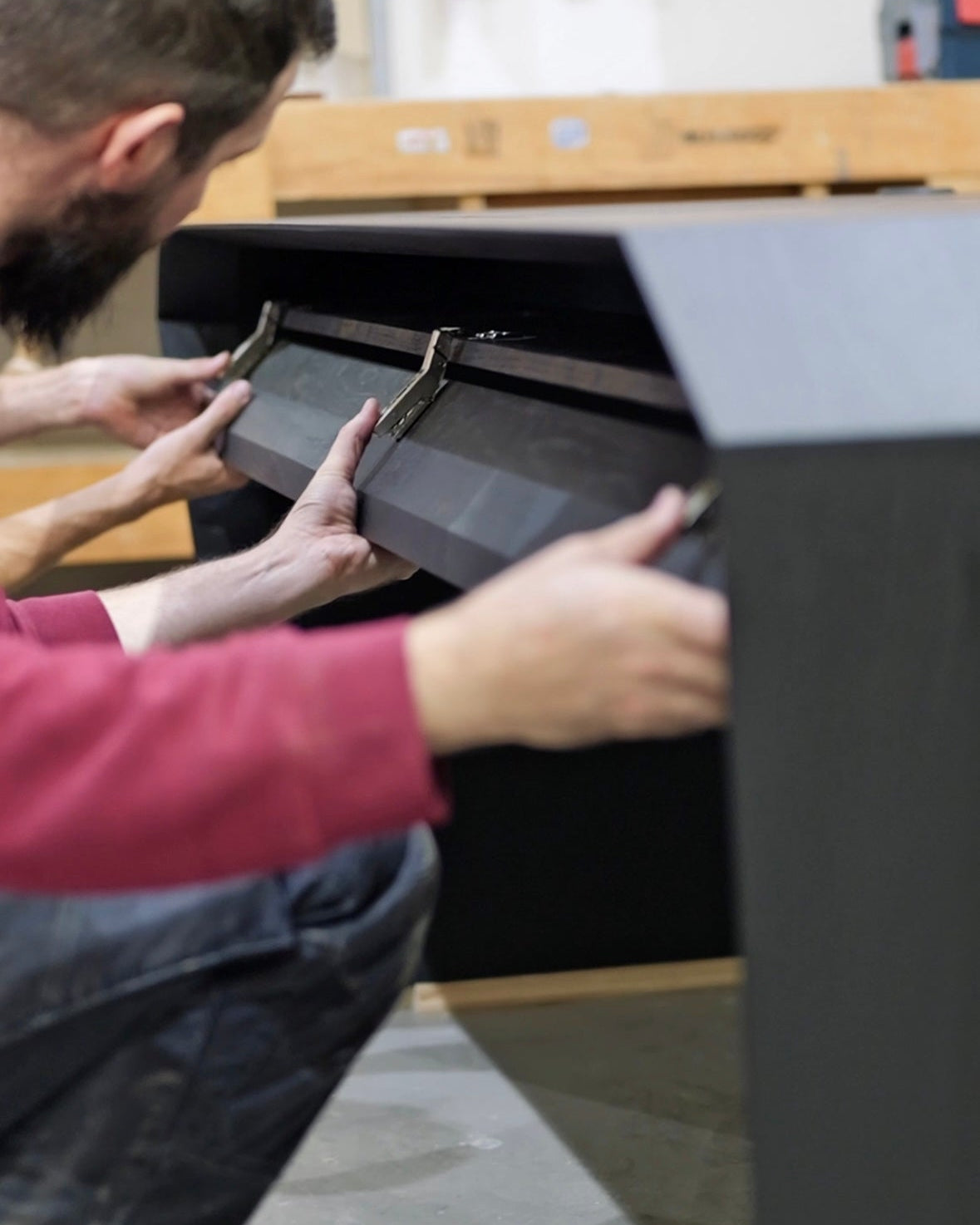
The best place to see how “real all the way through” becomes a finished desk is the workshop. Every top starts as a rough-sawn board, here in American walnut. From these boards, through selecting, cutting and gluing up, comes the continuous solid timber top that ends up as the desk. No carrier board, no glued-on layer of real wood: what you see at the finished edge runs through the whole piece.


Looks and the feel of the room: light and open, or dark and calm
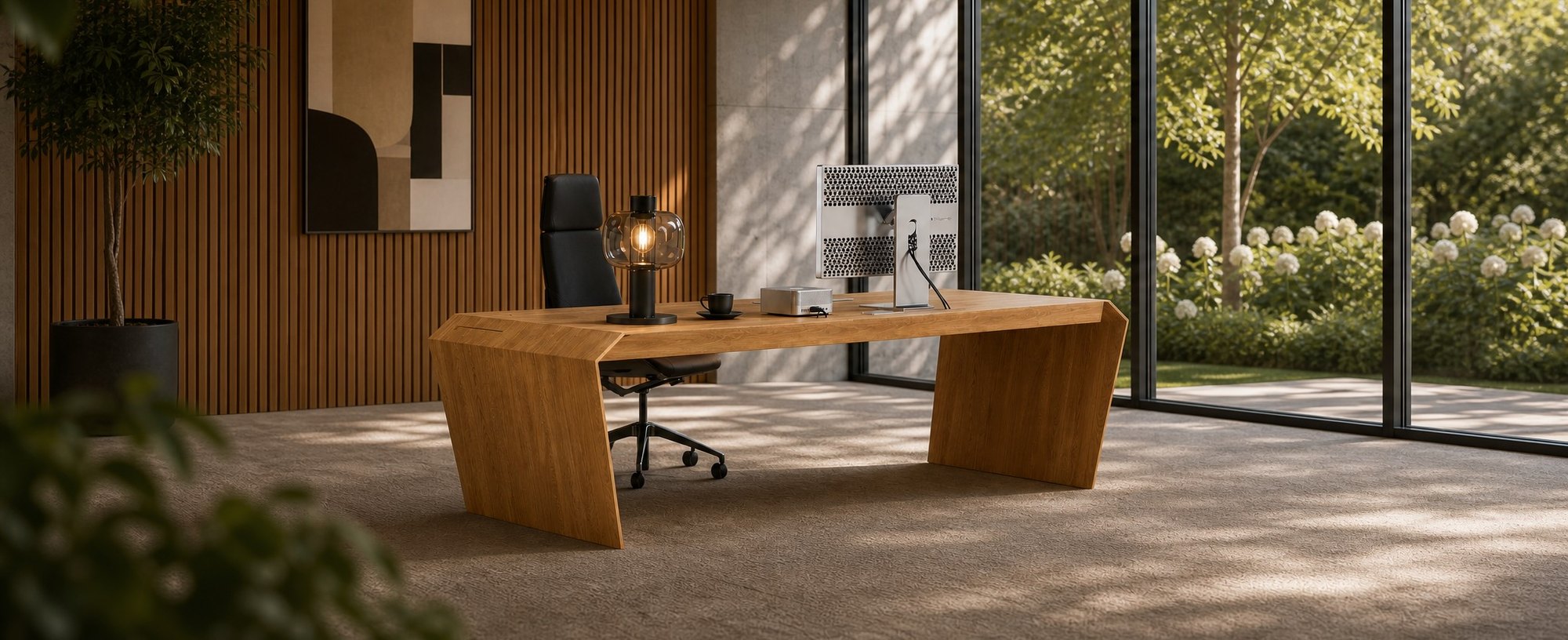
The biggest difference is the first one everybody sees. Oak is light, clear and versatile. Its distinctive grain gives structure without making the room feel smaller. A light desk makes the office feel more open, in a minimalist loft just as in a period flat. If your room is on the small side or short of light, oak is almost always the safe choice.
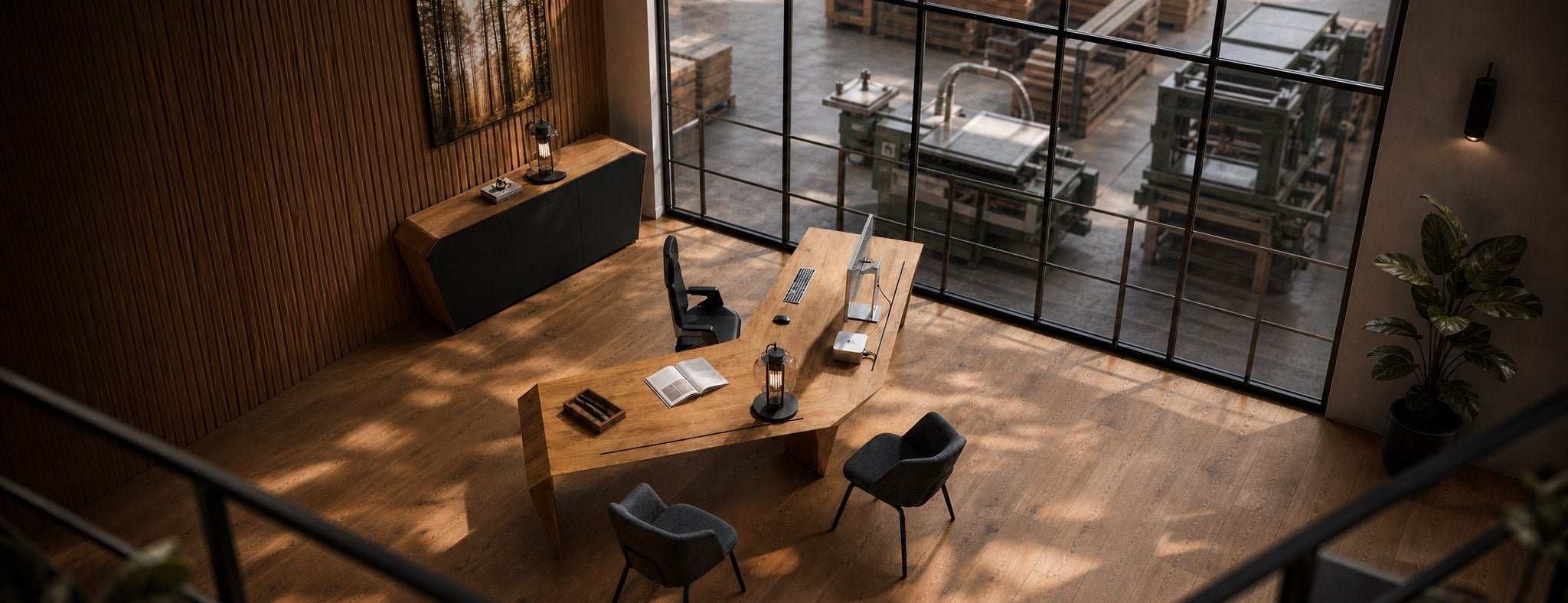
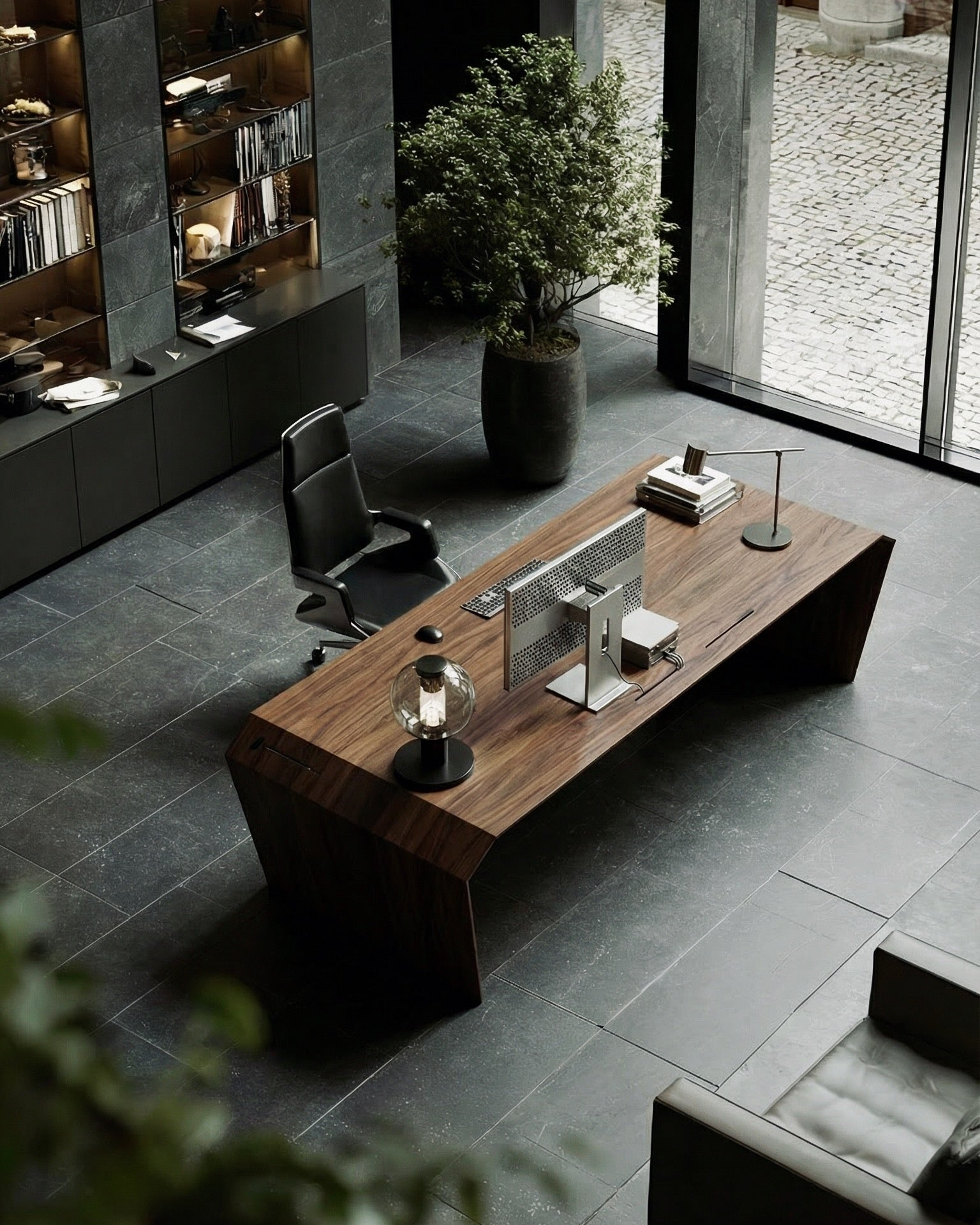
American walnut is the opposite: dark, warm and decidedly refined. The colour runs from chocolate brown to an almost violet grey, and the grain is finer and more flowing. Walnut brings weight and presence to a room straight away. It’s the timber for the top floor, the corner office, the moment when a piece has to radiate authority through its presence alone. To be honest about it: in very small or dark rooms a large dark desk can feel overpowering. A large corner desk in walnut needs floor space and, ideally, light.
Oak opens a room up, walnut fills it. Neither is better. It depends on what your office needs right now.

“I wasn’t sure about the colour. White was out, with the plain oak I wasn’t sure because of the floor, and I didn’t want it completely black. If I’m buying a real wood desk I want to see that it is one. When I saw the smoked-oak tone I thought: that’s it, that’s where the grain comes through.”
The three standard finishes
Three finishes are standard: you see them straight away as product renderings in the shop, and you can order them without a special request.
- Golden Timber: oiled oak with a golden undertone. The oil lets the grain speak without sealing it in. The most popular choice and the best starting point if you’re unsure.
- Deep Walnut: American walnut, also oiled, with all the dark warmth of the timber. Important: this is real walnut, not oak stained dark. The depth comes from the wood itself, from solid boards that we glue up into one continuous top in the workshop.
- Midnight Noir: oak stained black and lacquered, an almost black anthracite with the oak grain still visible and tangible under your hand. It combines the toughness of oak with a cool, graphic colour. For purist, dark interiors it’s often the most interesting choice.

The fourth finish: Smoked Amber
Alongside the three classics there is Smoked Amber. The real result is best judged on a wood sample.
- Smoked Amber: oak, stained and lacquered in a smoked-oak tone. It gives the timber a warm, smoky brown that sits between the two, without being as dark as walnut.
If none of the four finishes is quite your shade, an individual colour can be discussed as a custom build.
“We knew from the start: we’re going all black. So only Midnight Noir came into question, and it’s a perfect fit.”
Hardness and everyday use
Here there is a real, measurable difference. Oak is one of the hardest European timbers and stands up very well to scratches and dents. American walnut is a hardwood too, but a touch softer. In practice that means both cope easily with everyday office life, with laptop, notebooks and coffee cup. If you tend to be rough with things, or sometimes do a bit of hands-on work at the desk, oak gives you the bigger reserves.
Golden Timber and Deep Walnut are oiled, not lacquered. Oil soaks into the timber and lets it breathe, instead of laying a hard film over it. The advantage: it feels natural, and it can be touched up in one spot. The price for that is a little more attention than a sealed top needs. More on that in a moment, under care.
The right height: 76 cm as standard, your own measurement on request
Alongside wood and model, you also decide on the working height when you order. The standard is 76 cm, the classic desk height that suits most people. But you can choose the height freely between 72 and 82 cm, to suit your height and the way you sit. That isn’t a mechanism for adjusting it. It’s your own fixed height, and we build the desk to it.
If you’re on the tall side or like a slightly higher work surface, you simply tell us when you order. The desk is not electrically height-adjustable and it isn’t a sit-stand model. It arrives built to measure, at exactly the height that’s right for you. If you’re unsure which height suits you, we clear that up together in a consultation.

Patina: how both timbers age
Solid timber is alive, and both woods change over the years. That isn’t a fault. It’s the real appeal compared with a plastic top, which can only get worse from day one.
Oak darkens slightly in the light and takes on a warmer, more golden tone. Walnut goes the other way: the very dark, sometimes violet-tinged tone of the early days settles into an even, warm brown. Both changes are slow and even. If you want to keep the look constant for a long time, don’t put the desk in full midday sun. That goes for any natural timber.
Care: honest, but uncomplicated
Day to day, both timbers are easy to look after. Oiled wood repels water but isn’t waterproof, so a few rules are enough:
- Wipe dust and crumbs away with a slightly damp, soft cloth, then wipe dry.
- Mop up liquids promptly rather than leaving them to stand.
- No aggressive cleaners, no abrasive microfibre cloths, no glass cleaner.
Once or twice a year, depending on how hard the top works, treat it to a fresh coat of care oil. It takes half an hour: apply thinly, let it soak in, wipe off the excess. Re-oiling tops up the surface, deepens the colour and makes small signs of use disappear. This is exactly where solid timber with an oiled finish is strongest: a scratched patch isn’t a case for the skip, it’s a case for a cloth and a little oil. For walnut we recommend a dark care oil, for oak a colourless or light one.
Which wood suits which office style?
As a guide, not a rule. In the end your own eye decides:
- Oak (Golden Timber): for bright, modern and Scandinavian-influenced offices, smaller rooms and plenty of daylight. The uncomplicated, versatile choice on the DeskPURE, and it goes with almost any wall colour and floor.
- Walnut (Deep Walnut): for the top floor, the corner office and classic, elegant interiors. If you want to show authority to the outside world, say in the conference room or at an executive desk with drawers, walnut is the right call.
- Midnight Noir: for purist, graphic, monochrome rooms. For anyone who wants the dark look, but cool rather than warm.
If the desk is to become an Ensemble with a matching sideboard or coffee table, think of all the pieces in the same wood. It looks calmer than a mix.
The most honest way to decide: the wood samples
No screen reproduces a timber surface exactly. Colours shift from one monitor to the next, and how oak or walnut looks in your light, next to your wall and on your floor can only be judged in the real room. That’s exactly what the wood sample is for: you hold the finishes in your hand, put them against the wall and decide when you genuinely can.
We recommend this step to anyone who is torn. A desk stays with you for many years, and the few days for a sample are well spent. If questions remain, the direct route is a personal consultation, where we go through wood, model and size together. We can clear up business leasing (Germany only) there too. If the wood is already settled, put the desk together in the configurator with model, dimensions and add-ons, and see the price straight away.

Worth a read: which colour suits your floor, your walls and your light, shown with room comparisons in all four finishes: Which colour for your desk?
Frequently asked questions
Is oak or walnut harder and more scratch-resistant?
Which wood suits a small or dark room?
How do I care for an oiled oak or walnut desk?
Is Deep Walnut real walnut or stained oak?
How high is the desk, and can I change it?
How many finishes are there altogether?
Does the colour of the wood change over time?
How do I find out which wood really suits my room?
In short: two characters, one right decision, and it’s yours
Oak or walnut isn’t a question of better or worse, but of room, light and taste. Oak is the light, versatile and slightly tougher choice for modern, smaller or poorly lit offices. Walnut is the dark, warm timber with presence for larger rooms where people are received. Both are 26 mm solid timber, both oiled, both get more beautiful with the years. Because no monitor tells the truth about a timber tone, the most honest last step is the wood sample in your own light.
Still torn between oak and walnut?
We’ll talk your project through with you personally, or you go straight to the model that fits.

Philipp Strobel is a qualified automotive engineer. He brings an engineer’s way of thinking to running a business, and develops desks in which function and design come out of one system. He has been developing products in wood since 2017, and since 2024, with EDELHOLZ, desks for business owners.