


König & Delacroix: the tax firm that convinces without a word
Most tax firms look like tax firms. Grey carpet, a wall of shelving, a swivel chair, an art print. Functional, but interchangeable. Yet clients decide within seconds whether they want to stay. Not because of the accounts. Because of the room. König & Delacroix is a concept by EDELHOLZ Manufaktur. A vision of what a tax firm could look like if it convinced without a word. Not a real project, but a real ambition: to show what’s possible when rooms have a point of view.

At a glance
|
Context
|
The building blocks
|
|
The result
A firm that builds trust before the first word is spoken. Rooms that show competence without boasting about it. And a working environment that convinces clients and attracts the best people. |
|
Why most tax firms look the same, and what it costs them
Picture walking into a tax firm. White corridor. Open-plan office. Desks from the office furniture catalogue. A plant that has seen better days. The tax adviser may be brilliant. But the room tells a different story. It says: this is about efficiency, not about you.
Clients who come to talk about family offices, succession or six-figure tax questions don’t expect luxury. But they expect substance. They read rooms the way they read accounts, and they draw conclusions. A cheap desk says: they cut corners here. A well-considered room says: they think here.
That’s exactly where our concept comes in. König & Delacroix isn’t a real firm. It’s a vision of what tax advice could look like if the room worked as precisely as the advice itself. Every room has a job. Every material has a message. And EDELHOLZ solid timber furniture forms the foundation.
König & Delacroix: the rooms at a glance


Eleven views of one principle: warm timber inside a historic shell. Modern solid timber furniture meets the character of a period building, and both come out stronger.
The arrival: when the building speaks before you step inside
Cobblestones. Autumn leaves. A discreet brass plaque beside the entrance. No illuminated sign, no company logo. A client arriving for the first time doesn’t see an office building. They see a house with a history. Trust doesn’t begin with the first sentence. It begins with the first impression.
Location tip: a period building communicates values no logo can carry. A stuccoed facade and a settled neighbourhood do their work before the client opens the door.
Reception: where first contact becomes the first impression
In the first five seconds a judgement forms that is rarely revised. At König & Delacroix the receptionist sits behind a DeskPURE used as a counter. Solid timber, clear lines. Behind it an arched doorway that hints at depth. No open-plan office. Instead, a threshold between public and private.
Client tip: your reception area should convey warmth and signal discretion. A solid counter does both: welcoming, without being transparent.

The sideboard: order as a material statement
In the foyer stands a StudioPURE sideboard. Not as somewhere to put things, but as a point of view. Behind it, brass wall lights; above it, a gold mirror. On the sideboard: almost nothing. Empty surfaces are a luxury in a tax firm. They say: we have room enough. The solid timber sets the material tone for the whole space, a thread of oak that runs through every room.
Material tip: choose a wood that gets on with the historic materials. Oak almost always works: warm enough for plasterwork and parquet, modern enough for clean furniture lines.
The client lounge: where trust is built, and it isn’t at the desk
The most important conversations happen where people feel at ease. A fireplace. Two armchairs in green velvet. Between them a LoungePURE coffee table in solid timber. No desk, no screen, no barrier. Adviser and client sit as equals. The LoungePURE is more than a piece of furniture here: it’s the centre of a room built for trust.
Conversation tip: hold first meetings and sensitive subjects such as succession in the lounge, not in the office. The informal atmosphere opens doors that a desk keeps shut.
The partner’s office: where decisions are made, and the room thinks with you
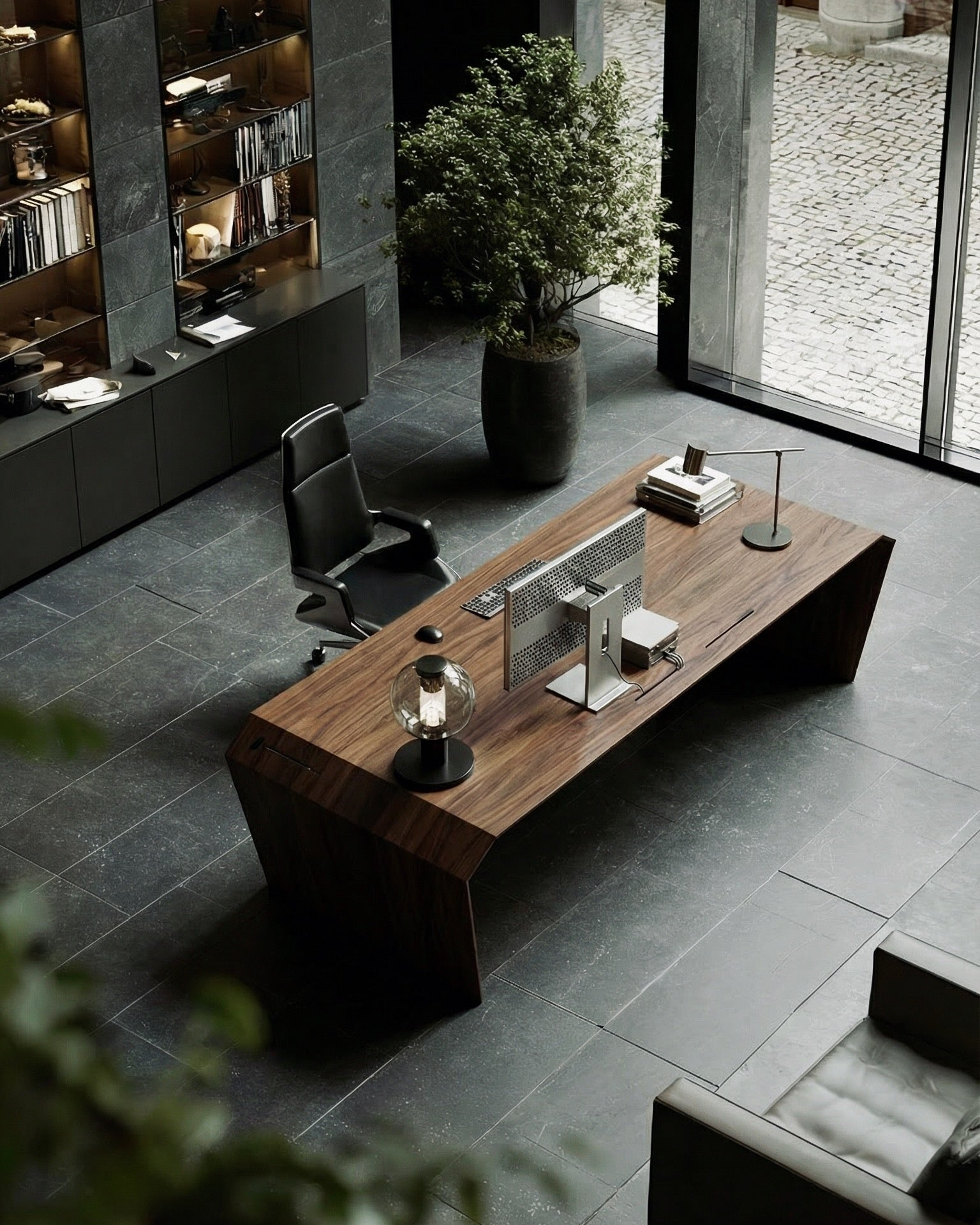
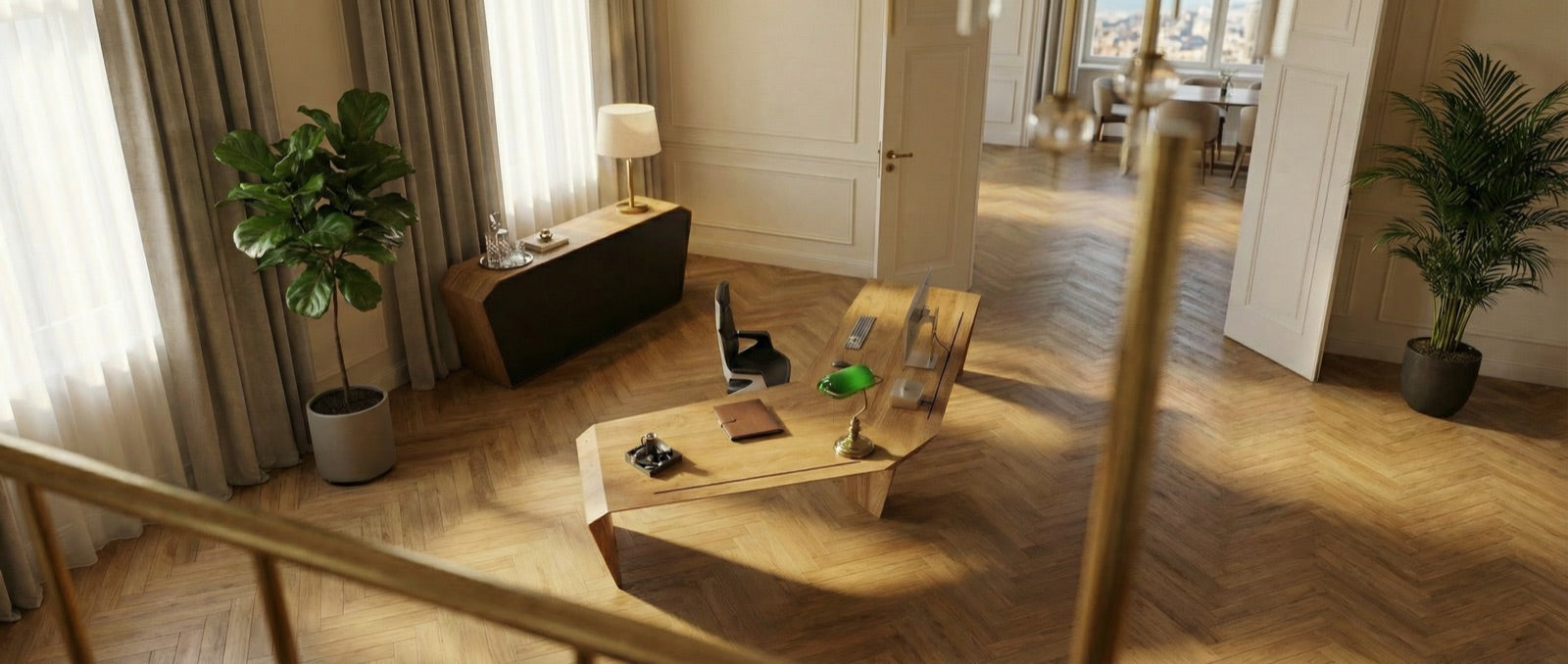
The heart of the firm. As an L-shaped desk, the ArcPURE has room for two screens and files without ever looking overloaded. The clear lines of the solid timber stand in contrast to the green velvet curtains and cream plaster-panelled walls. When a client walks into this office, they don’t see a desk. They see a point of view.
Layout tip: position the desk so that a client walking in sees the window wall, not your screen. The room should make the impression, not the spreadsheet.
The library: making knowledge visible, without putting it on display
Floor-to-ceiling shelving for files. A library ladder in brass and timber. In the middle of it, a DeskPURE where an associate works. The depth of the firm’s expertise becomes something you can physically feel: thousands of pages of case law, not hidden away digitally but there to be touched. That earns respect.
Room tip: two floor-to-ceiling walls of reference books are enough. The effect: visible competence that no certificate on the wall can replace.
The meeting room: why round tables produce rounded solutions
No long table with a seat at the head. In the meeting room stands a round oak table. Six chairs. A fireplace. At a round table there is no hierarchy, and that changes conversations. Shareholder meetings, family foundations, mediations: everything works better when the room signals that everyone is equal.
Meeting tip: do without a rectangular table. A round table in solid timber changes the dynamic, and with it the outcome.
The kitchenette: where culture is made, and it isn’t in the mission statement
A firm’s culture isn’t defined in workshops. It grows in the kitchen: over coffee, at lunch, between two client appointments. An oak kitchen run, a round table, a view into the lounge. Not a staff room in the basement, but a place held to the same standard as the rest of the firm.
Culture tip: invest in your kitchenette as you would in your reception. Your team spends more time there than any client ever will.
The detail: why the guest WC gives away more than the business card
A natural stone washstand. Brass taps. Herringbone parquet that carries straight on from the corridor. No break, no compromise: the same care as in the partner’s office. Brass runs as a thread through the entire firm: wall lights, door handles, shelf fittings, taps. Most people don’t consciously notice it. But it works on them.
Detail tip: choose one accent material and carry it through every room without exception. The effect comes not from the single piece but from the repetition.
The corridor: why the way between the rooms isn’t dead space
In most offices the corridor is what’s left over between the rooms. At König & Delacroix it’s a room in its own right: brass wall lights set points of light, plaster panels structure the walls, herringbone parquet leads the eye forward. A client being shown from reception to the meeting room walks through a staged sequence, and every step builds expectation.
Architecture tip: don’t treat your corridor as leftover space. Two wall lights, a runner, one picture. It needs no more than that. But it needs intent.
Employer branding: why your office is your best recruiting tool
Tax advice has a problem: a shortage of skilled people. Firms outbid each other with perks: home office, fruit baskets, company cars. But the strongest magnet gets overlooked: the room people work in. Younger professionals choose employers by aesthetics too. A firm with herringbone parquet and solid timber desks isn’t a gimmick. It says something.
König & Delacroix shows what that can look like. The library is held to the same standard as the partner’s office. The kitchenette to the same as the client lounge. That signals something no job advert can carry: everyone here is taken seriously.
The blueprint: seven principles for tax firms with a point of view
1) Consistent material builds trust
If the reception counter is oak, the partner’s office walnut and the meeting table MDF, there is no concept. EDELHOLZ solid timber desks are available in the same woods across the range. The thread runs through by itself.
2) Period character isn’t an obstacle. It’s an advantage
High ceilings convey generosity. Plasterwork conveys history. Modern solid timber furniture provides the contrast that lets a period building come into its own.
3) Details give the attitude away
Cheap door handles, plastic light switches, a waste-paper bin from the DIY store: all of it registers. The answer is consistency: one accent material that runs through every room.
4) Invisible technology doesn’t intrude
In a firm built to receive clients, technology must not be on show. EDELHOLZ desks offer CableHIDE and PowerPORT, which make cables and sockets disappear.
5) Client rooms are rooms for trust
The meeting room is where a client lays open their financial affairs. Solid doors, no glass walls. The room has to say: what’s discussed here stays here.
6) The team deserves the same standard
Fitting out only the client rooms and leaving the team to work in a back room is a mistake. A DeskPURE for a tax assistant isn’t a waste. It’s an investment in loyalty and performance.
7) Interiors are a business expense, and an investment
Under German depreciation tables, the useful life of office furniture is 13 years. A solid timber desk lasts a good deal longer. Invest in quality once and you won’t be buying again in five years.
FAQ: fitting out a tax firm with solid timber
Why is solid timber worth it for a tax firm?
Which wood suits a firm best, oak or walnut?
How does the office interior affect the impression on clients?
Can office furniture for the firm be claimed against tax?
How do I combine period charm with modern office furniture?
What does it cost to fit out a tax firm with solid timber furniture?
Does a good office interior help with the skills shortage in tax advice?
In short: fit out a tax firm with a point of view, not a catalogue
König & Delacroix is a concept. A vision. Not a real project, but a realistic one. Every room we’ve shown can be built. Not exactly like this. But with the same ambition: that rooms don’t just function, they communicate.
If you’re fitting out or refurbishing a tax firm, don’t start with furniture. Start with the question: what should my room say about me? About my firm? About my attitude towards clients and team? The answer determines everything that follows, from the desk to the taps.
Solid timber isn’t a luxury here. It’s a decision for permanence. For material with character. For furniture that looks better in ten years than it does today. If you’d like to know which EDELHOLZ pieces suit your firm, let’s talk.
Book a consultationWould you like your set-up to work like this?
A personal conversation with Philipp Strobel. Free, no obligation, with concrete recommendations.

Philipp Strobel is a qualified automotive engineer. He brings an engineer’s way of thinking to running a business, and develops desks in which function and design come out of one system. He has been developing products in wood since 2017, and since 2024, with EDELHOLZ, desks for business owners. The result: well-considered desks with clean lines, built-in technology and function you notice every working day.


